
How would you like to take a journey back in time? Set out to explore the underground world hidden beneath the limestone plateaux of the Quercy. The caves of the Lot reveal a remarkable natural and historical heritage: limestone formations of extraordinary shapes, underground rivers, caves adorned with paintings and engravings, and precious traces of prehistoric life.
At the crossroads of geology, art and history, some of these caves bear witness to the evolution of the landscape over millions of years, while others preserve the traces left by our ancestors and some of humanity’s earliest forms of artistic expression.
With Cahors as your starting point, these excursions offer another way to discover the region, whether you are travelling as a couple or with your family. They appeal equally to heritage enthusiasts and those with a passion for nature and prehistory.
From the famous Padirac Chasm to the prehistoric paintings of Pech Merle, discover our selection of eight unmissable underground sites in the Lot, each with its own distinctive character. Which one will capture your imagination?
Why Is the Lot Home to So Many Caves?
To understand why the Lot is home to so many caves, we need to go back several million years. The limestone plateaux known as the Causses du Quercy are largely composed of rocks formed from sediments that accumulated on the seabed of ancient seas that once covered the region.
Over time, rainwater seeped into cracks in the rock, gradually dissolving the limestone and carving out an extensive network of passages, cavities and underground rivers. This is what is known as a karst landscape. Inside the caves, water continues its work: drop by drop, it deposits calcite, forming stalactites that hang from the ceilings and stalagmites that rise from the ground.
This natural process, which continues to this day, has shaped much of the Quercy landscape. The region’s remarkable geological heritage is recognised through the designation of the Causses du Quercy as a UNESCO Global Geopark.
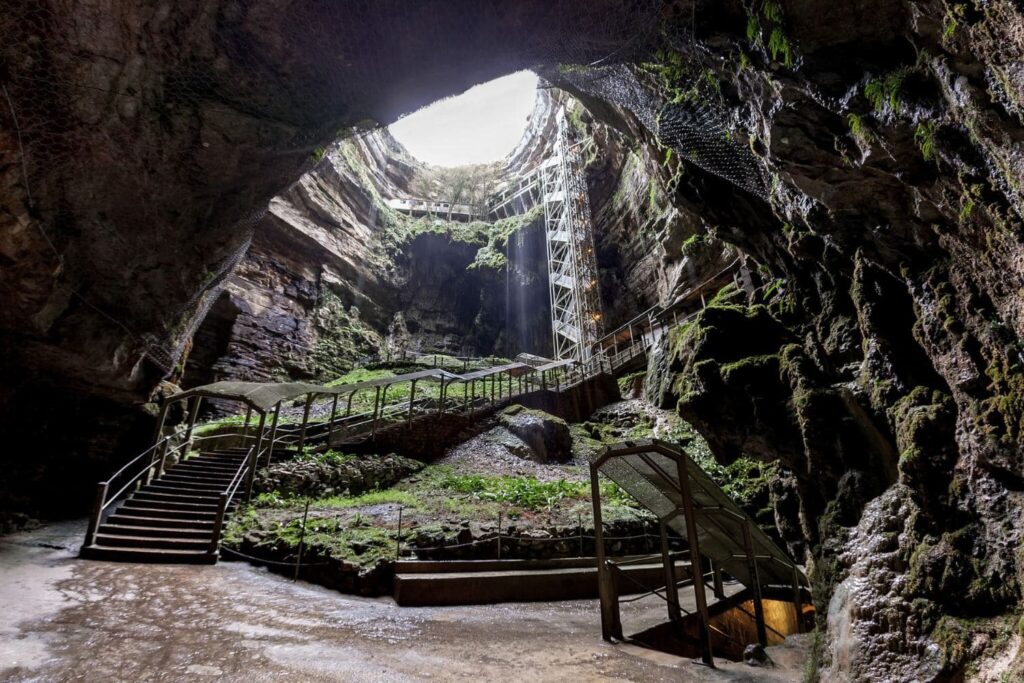
The impressive natural opening of the Padirac Chasm, shaped by the erosion of limestone. © Louis Nespoulous
Unmissable Caves and Chasms in the Lot
From iconic landmarks to lesser-known caves, the Lot offers a wonderfully varied choice of underground experiences. Each site has its own story, natural curiosities and distinctive way of revealing its secrets. Here are eight places to explore during your travels through the Quercy.
The Padirac Chasm
On the limestone plateau of Gramat lies a particularly spectacular natural wonder. After descending into an immense chasm, you reach a network of passages around 100 metres below ground before boarding a boat for a journey along the underground river. Among the sights you encounter along the way is the Grande Pendeloque, an impressive stalactite measuring 60 metres in length.
The exploration continues on foot, past the natural pools of the Lac des Gours and into the majestic Grand Dôme chamber, whose vaulted ceiling rises to a height of 94 metres.
This is what makes the Padirac Chasm so distinctive: a visit that combines underground exploration, a boat trip and the discovery of mineral formations on an extraordinary scale. This 90-minute journey, covering around two kilometres, is one you will remember for years to come.
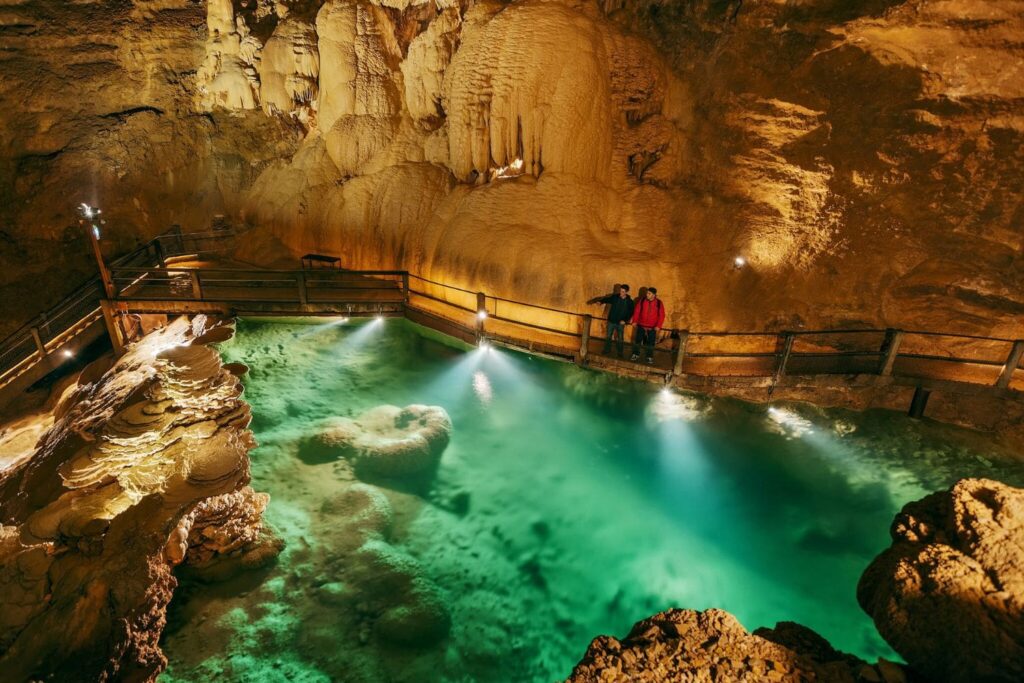
The Upper Lake of the Padirac Chasm and the majestic limestone formations of the Grand Dôme chamber. © Louis Nespoulous
Pech Merle Cave in Cabrerets
If you are planning to explore Saint-Cirq-Lapopie, take the time to stop in Cabrerets, in the Célé Valley. Art and history enthusiasts will appreciate this authentic decorated cave, which preserves paintings and engravings dating back to the Palaeolithic period.
Horses, mammoths, bison, hand stencils and symbols painted on the walls tell the story of a distant past. Among the approximately 800 motifs recorded in the cave, including more than 70 animal representations, the famous Spotted Horses panel bears witness to the artistic skill of prehistoric people nearly 30,000 years ago. Perhaps even more moving are the human footprints still preserved in the cave floor.
Visits are by guided tour only and last one hour. The route is fairly physically demanding, with 300 steps spread across several levels. To delve a little deeper into the prehistoric world, take the time to visit the Amédée Lemozi Museum, located on the same site.
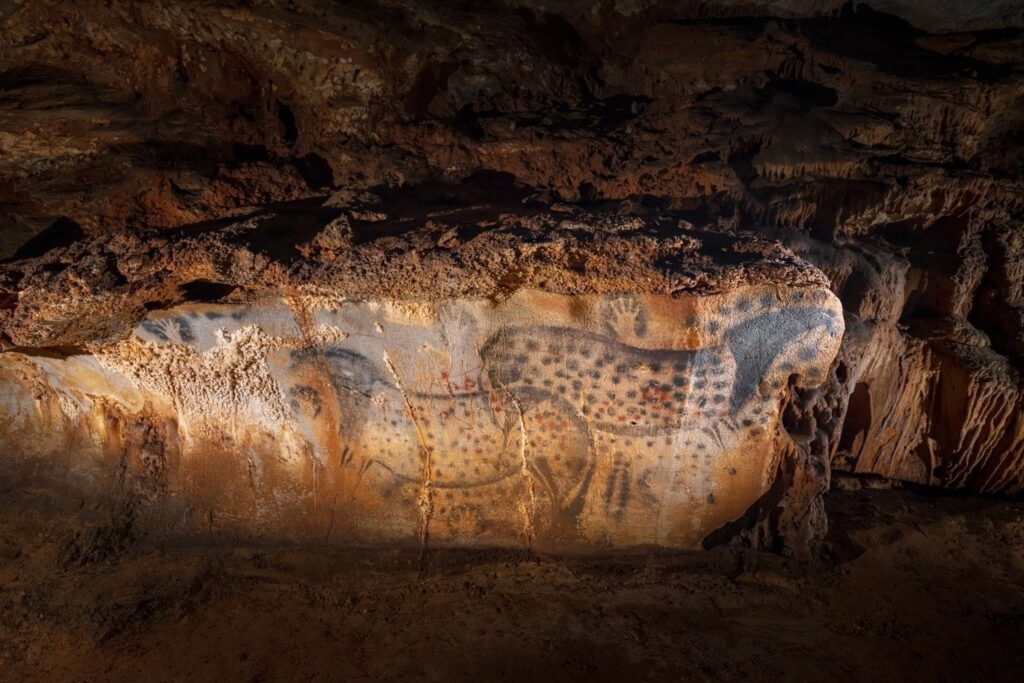
The famous Spotted Horses panel, a remarkable example of Palaeolithic cave art. © Rémi Flament
The Lacave Caves
Head to the Dordogne Valley, between Souillac and Rocamadour, for an underground adventure that is both entertaining and enchanting.
A small electric train takes you nearly 400 metres into the hillside. The visit then continues on foot in the company of a guide, through twelve chambers offering a variety of underground landscapes. From the Chaos Chamber to the Chamber of the Lakes, carefully arranged lighting reveals striking limestone formations reflected in the subterranean waters.
The highlight of the visit? The Chamber of Wonders, also known as the Black Light Chamber, where, across an area of nearly 2,000 square metres, ultraviolet light reveals the natural fluorescence of certain mineral formations.
Allow around one hour and 15 minutes for a visit that is sure to delight children and adults alike.
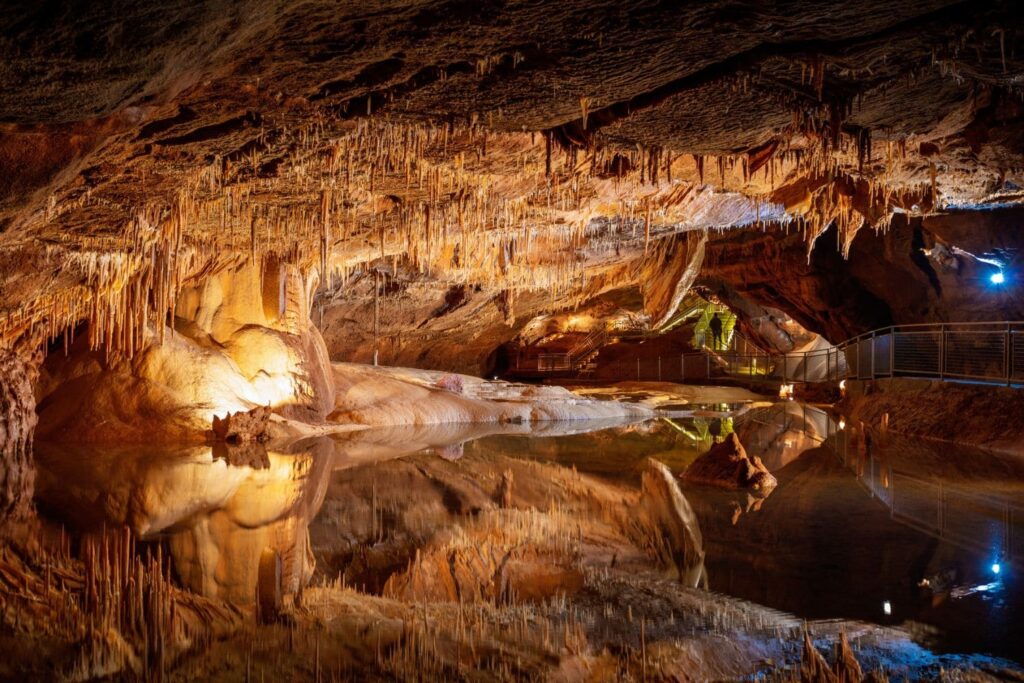
At the Lacave Caves, the interplay of light and reflections on the water reveals the full beauty of the mineral formations. © Asphéries | Hervé Leclair
The Cougnac Caves in Payrignac
Just outside Gourdon, this fascinating site invites you to discover two caves, each offering a very different experience.
In the first, you embark on a geological exploration beneath a ceiling adorned with thousands of slender stalactites. Some of the most delicate and translucent formations are known as soda straw stalactites.
The second takes you back to prehistoric times, with depictions of mammoths, ibex, giant deer (an extinct member of the deer family), as well as rare human figures. The earliest paintings date back nearly 30,000 years. One of the distinctive features of this cave art is the skill with which Palaeolithic artists used the natural contours of the rock to give their animal figures a three-dimensional appearance.
Allow around one hour to explore both caves on a guided tour limited to 25 visitors. The temperature inside remains a constant 13°C, even in summer.
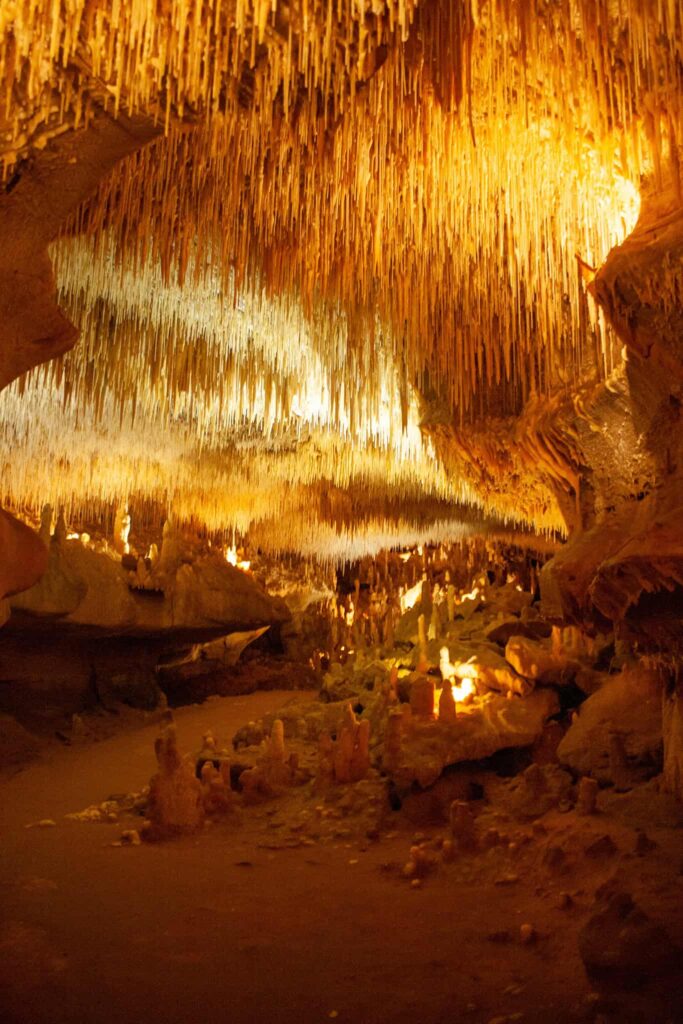
A delicate curtain of soda straw stalactites hanging from the ceiling of the Cougnac Caves. © C. Asquier | Lot Tourisme
The Grotte des Merveilles in Rocamadour
The hamlet of L’Hospitalet, overlooking Rocamadour, is home to a prehistoric decorated cave. Situated above the Alzou Canyon, it is best known for its cave paintings dating back around 25,000 years, which include horses, deer, a feline and several hand stencils.
Here, you can discover the pigment-blowing technique used by prehistoric artists. To create a hand stencil, Palaeolithic artists placed their hand against the cave wall before blowing pigment around it, either directly from the mouth or through a hollow tube. Once the hand was removed, its silhouette remained visible on the rock.
Discovered in 1920 and listed as a historic monument since 1925, the Grotte des Merveilles can be explored on a 45-minute guided tour. Remember to book your visit by telephone, as advance reservations are compulsory. The cave is closed during the winter months.
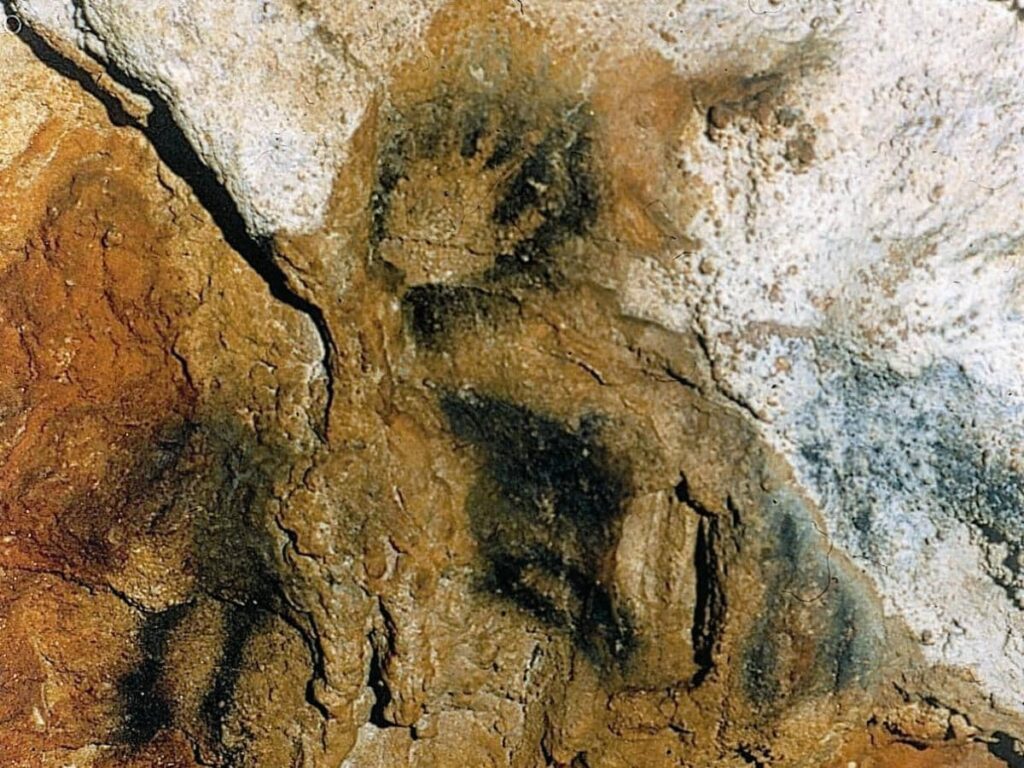
A horse and a hand stencil, bearing witness to the artistic skill of Palaeolithic people. © Grotte des Merveilles
The Carbonnières Cave in Lacave
During your visit to Rocamadour, be sure to discover the Carbonnières Cave, located just six kilometres from the medieval village. Visitors come to admire its limestone formations, with their fascinating variety of shapes and colours.
Along the 350 metres of underground passages, you pass through six spacious chambers filled with stalactites, stalagmites, flowstone draperies, columns, soda straw stalactites and helictites. You may even spot remarkable oak roots growing through the cave ceiling. Have fun imagining what the different formations resemble and let your children’s imaginations run free. The passages light up as you make your way through the cave, before a sound and light show in the Chamber of Echoes.
Visits are self-guided, with no advance booking required, allowing you to explore at your own pace with the help of an informative booklet. Allow around 45 minutes to follow this entirely step-free route, which is also suitable for pushchairs.
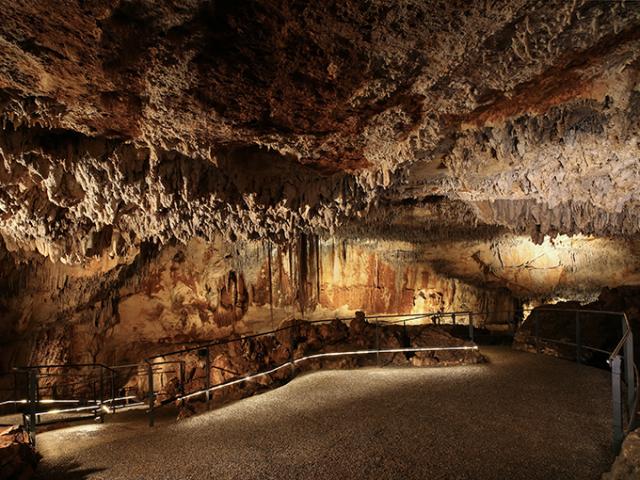
The Carbonnières Cave and its wealth of mineral formations. © Grotte des Carbonnières
The Presque Caves in Saint-Médard-de-Presque
Not far from Saint-Céré, in the Haut-Quercy, the Presque Caves are best known for their impressive stalagmites. Nicknamed the ‘Cave of Columns’, they are home to majestic stalagmitic pillars, some reaching more than nine metres in height.
While certain formations, known as the ‘Pillars of Hercules’, impress with their sheer size, others stand out for their delicacy, such as the ‘Candles’, two particularly slender, almost translucent columns. The natural shades of the mineral formations add to the beauty of the surroundings.
Discovered by chance in 1825 during road construction, the Presque Caves have been open to the public since 1922. Allow around 45 minutes for a guided tour of this remarkable display of underground geology.
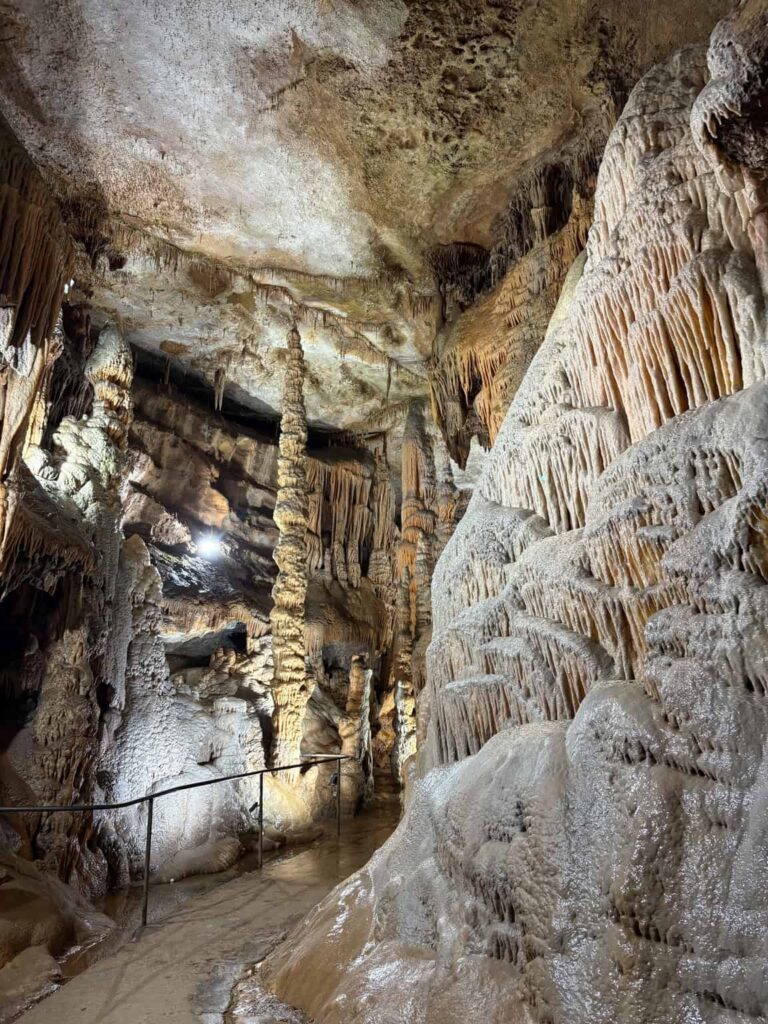
The elegance of the stalagmitic columns for which the Presque Caves are renowned. © Cathy Seguy | Lot Tourisme
The Cloup d’Aural Phosphate Mines in Bach
Our journey takes us to Bach, within the Causses du Quercy UNESCO Global Geopark and the Lot National Nature Reserve of Geological Interest. Here, we discover remarkable open-air cavities where lush vegetation now flourishes.
Mined for phosphate in the late nineteenth century, these former workings are now an important site for palaeontological research. The numerous fossils unearthed in the phosphate deposits of the Quercy, representing more than 700 species, reveal how wildlife, landscapes and the climate evolved over nearly 30 million years. It is a fascinating insight into ancient ecosystems, at the only phosphate mine in the Quercy developed to welcome visitors.
Accompanied by a guide, you descend more than 20 metres to uncover the secrets of this former mine. Allow around one hour for the guided tour, which you can complement by exploring the themed trails and exhibition room at your leisure.
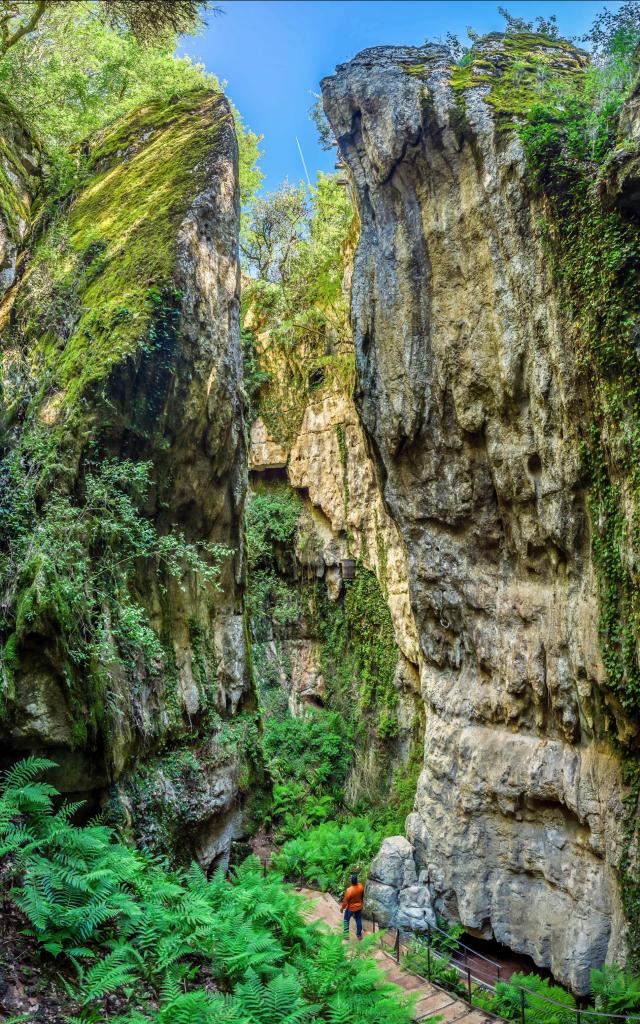
At the Cloup d’Aural phosphate mines, nature has reclaimed the former mining cavities. © Christophe Bouthe | Agence Vent d’Autan
Our Tips for Visiting the Caves of the Lot
Plan your visits ahead
Before setting out to explore the depths of the Quercy, remember to check the seasonal opening dates of each site. Some caves close during the winter months. During the high season, particularly over the school holidays, it is advisable to book your visits in advance, especially for decorated caves where visitor numbers are restricted to protect the prehistoric paintings.
Dress appropriately
Even in the height of summer, remember to bring an extra warm layer! Temperatures inside the caves generally range between 12 and 14°C. Comfortable footwear with good grip is also recommended, as the ground can be damp and slippery.
Choose a route suited to your needs
Travelling with young children? Check the accessibility of each site before choosing your excursion. Some routes involve numerous steps, while others have been adapted to accommodate families with pushchairs.
Respect these fragile environments
If you would like to capture your discoveries on camera, bear in mind that photography is not permitted in every cave. Please also refrain from touching the mineral formations or decorated walls. These simple precautions help preserve the beauty of this fragile heritage for future generations.
Where to Stay When Exploring the Caves of the Lot
If you are planning to explore the caves of the Lot, why not make yourself at home just outside Cahors? The location of the Domaine de Labarthe allows you to enjoy a variety of excursions, from the Célé Valley to the limestone plateaux of the Haut-Quercy, taking the time to appreciate the villages and landscapes along the way.
After a few hours spent underground, what a pleasure it is to rediscover the gentle pace of life in the Lot! Enjoy the tranquillity of our estate, unwind in the garden or round off your day with a glass of Cahors wine.
Whether travelling as a couple or with your family, our charming guest rooms and self-catering cottages welcome you for a stay at your own pace. Depending on your interests, complement your underground adventures with a stroll through the historic streets of Cahors, a walk across the limestone plateaux or a culinary excursion to meet local producers. Each offers another way to experience the many facets of the Lot.
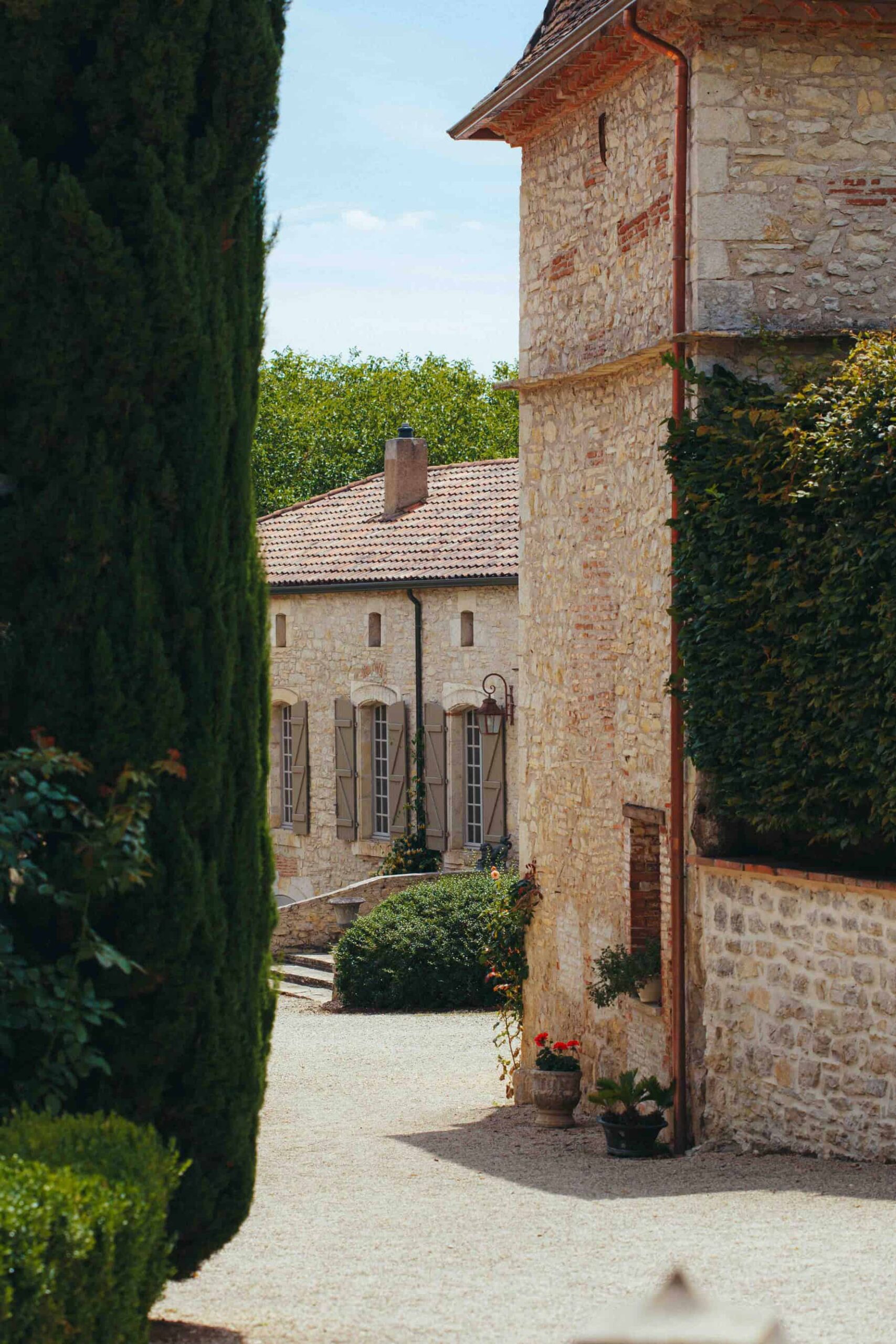
The Domaine de Labarthe, a charming retreat where you can savour the gentle pace of life in the Lot after a day of exploration. © David Rosemberg
The caves of the Lot never cease to surprise! They invite us to see the landscapes of the Causses du Quercy and their history in a different light. To continue your discoveries, why not explore some of the region’s other geological curiosities, such as the natural sinkholes of Aujols or the Plage aux Ptérosaures (Pterosaur Beach) in Crayssac? More delightful surprises await along the paths of the Lot. Enjoy your explorations!